
Nobody thinks about their drains until one quits working. A clog now and then is just part of owning a house, and it is not something you did wrong. But when the same drain backs up over and over, that is worth paying attention to.
A one-off clog is bad luck. A repeat is a message. It means the clog was never really the problem: it is the symptom of something else in the line.
Most folks handle a repeat by clearing it again, a little sooner each time. That is a perfectly sensible thing to do, and it works, right up until it doesn’t. What you end up with is the same fix rented over and over.
The good news is that a drain like this is usually telling you exactly what is wrong, and you can read most of it yourself before anybody runs a cable down your line. We’re No Clog Today, the drain and sewer crew at NCT Plumbing, and this is the call we take all day. Here’s how we’d think yours through.
Start with how fast it comes back
The interval is the best clue you have, and the useful part is that you already know it. You’ve been keeping track without meaning to. A drain doesn’t re-coat itself overnight, so how fast it returns tells you what kind of problem you’re dealing with.
Back within days? Nothing has had time to build up. Something is still in the line. The clearing got you flow through the middle of a blockage that never left, and the pipe closed up again as soon as normal use caught up.
A month or two? That points at the pipe wall. A cable can punch an opening through a packed line and get you draining again while leaving most of the coating right where it was. The opening closes in the order it opened.
Closer to a year? You’re nearer to ordinary buildup, especially on a kitchen line that works hard. That’s the one case where regular cleaning might honestly be the answer instead of a repair. Even then, it’s worth seeing what the inside of that pipe looks like before you settle into a schedule.
Then look at how much of the house is involved
The other half of the diagnosis is how many fixtures are in on it. This is the part that decides how urgent the call is.
One slow fixture on its own is almost always a local clog in that fixture’s branch line. Annoying, and usually a same-visit fix.
More than one fixture backing up at once is a different message. So is a toilet that gurgles when the washer drains, a tub that comes up when you flush, or a sewer smell that won’t go away. Those point at the main line, the pipe your whole house empties into. A main line in trouble keeps making clogs in every branch that feeds it, so clearing one fixture will never get ahead of it.
If that’s what you’re seeing, give us a call and we’ll get somebody out to you. You’re not overreacting: it’s the call we treat as urgent. There’s more on telling the two apart on our drain cleaning page.
What’s actually causing the repeat
Once you know the speed and the spread, the cause is usually one of four things. None of them are exotic, all of them are common around here, and every one of them can be dealt with. Each leaves its own fingerprint.
- Buildup that never really came out. Kitchen lines pack up with grease, soap, and food ground fine enough to slip past the strainer. It hardens on the pipe wall until the opening is about the width of a straw. Clear the blockage without cleaning that wall and you’ve bought a few weeks.
- A pipe that’s gone rough inside. Most Fort Worth-area homes built before 1980 still drain through cast iron. Decades in, cast iron corrodes from the inside out. The walls scale up and turn coarse, and a coarse wall grabs everything that touches it. No amount of clearing makes a rough pipe smooth again.
- A section that holds water. A drain line only works if it falls steadily toward the sewer. Ground that shifts under a house can take a length of pipe with it, leaving a low spot where waste sits instead of flowing. Solids settle at the low point, and they’ll settle there again.
- Roots at a joint. A hairline gap is all a root needs. Once it’s in, it grows toward the steadiest water in your yard and catches paper and waste like a net. Cutting the roots out gets the line flowing, but they grow back, because the gap that let them in is still there.
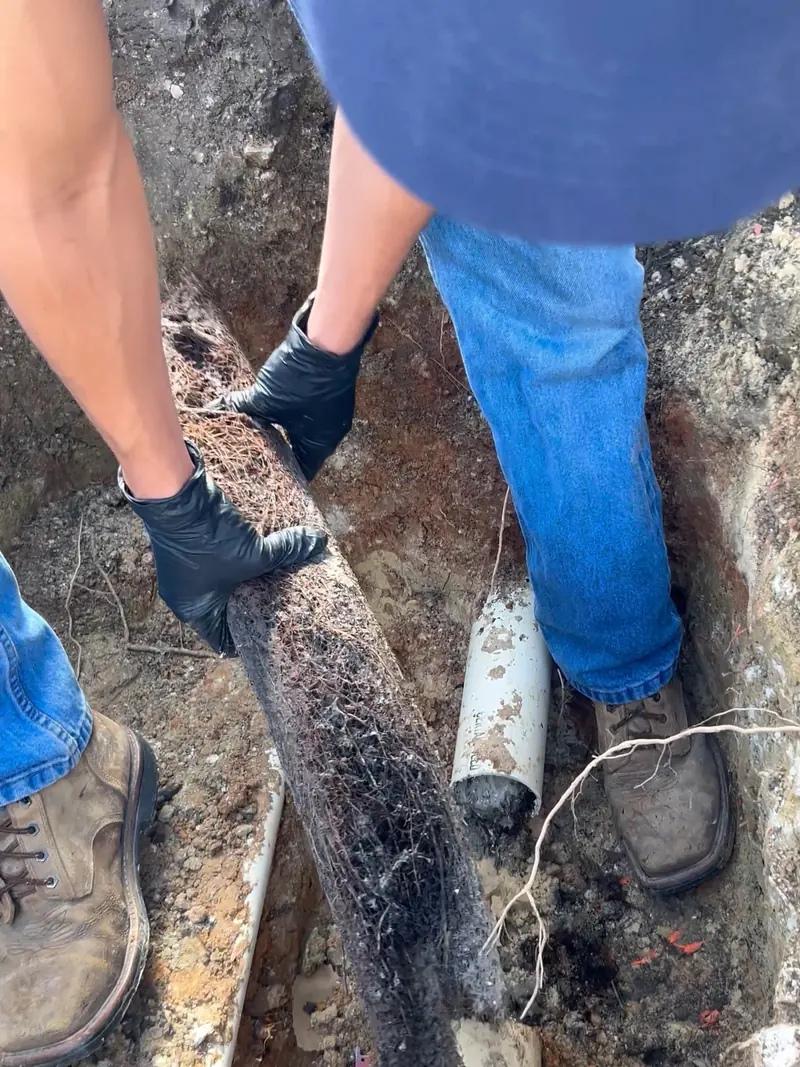
This length came out of the ground with the roots still wrapped through it. Clearing it worked every time, and every time it bought a few weeks, because the gap never closed.
What won’t stop it
If you’ve already tried some of these, you’re in good company. They’re the obvious things to reach for, and most repeat clogs have had every one of them thrown at it. Here’s why they don’t hold on a drain that keeps coming back.
- Chemical drain cleaner. It rarely clears a real clog. It eats a narrow channel through the middle that closes right back up, and it’s hard on your pipes besides. On a line that’s already blocked, the caustic stuff just sits there.
- Boiling water down a greasy kitchen drain. Heat moves grease, which is exactly the trouble. It travels a few feet, hits colder pipe, and sets up again somewhere harder to reach.
- A hanger or a plunger, on a clog that keeps returning. Both work on the trap, the bend right under the fixture. A clog that comes back on a schedule is hardly ever in the trap.
- Clearing it again on the same schedule. If you’ve landed on an interval that works, what you’ve really found is how fast the actual problem comes back.
What does stop it
Three things, in order.
Clear the pipe, not just the clog. Matching the tool to the pipe is most of the job. A cable machine reaches down the line and breaks the blockage out, and that’s the right call for most clogs.
When grease or scale has coated the pipe itself, a jetter scours the wall back to bare pipe with high-pressure water. You want the line running at full flow again, not a hole punched through a clog that never left.
Look at it. A camera settles what guessing can’t: is this buildup we can clean off, or is the pipe itself the problem? Scaled cast iron, a sagging section, and roots at a joint all feel the same from the fixture end. On camera they look nothing alike. We show you the footage on the spot.
Fix what the camera found. If it’s buildup, cleaning the line properly is the whole job, and that’s exactly what we’ll tell you. If it’s a length of failed pipe, that section is why the clogs keep coming, and it’ll keep making them until it’s repaired. Either way you get the real answer, not a sales pitch.
Keeping a cleared line clear
Once a line is genuinely clear, a few habits decide how long it stays that way. None of this is dramatic, and none of it asks you to be careful every minute. It just counts for more on older pipe.
- Cooking grease and fat go in the trash, not the sink. Wipe greasy pans out with a paper towel before they ever hit the water.
- Strainers in the kitchen and shower drains, emptied into the bin. Hair and food caught at the top never becomes a clog thirty feet down.
- Coffee grounds, rice, pasta, and fibrous peels belong in the bin. A disposal grinds food finer, it doesn’t make it disappear, and finer is exactly what packs into grease.
- Run the water a while after the disposal, so what you ground up actually leaves the line instead of settling in it.
- Down the toilet: waste and toilet paper, nothing else. Wipes sold as flushable clear the bowl and then quit breaking down, and they’re very good at catching on anything rough.
When to stop clearing and start fixing
We’d rather put this plainly than let it creep up on you. If you’re clearing the same line on a schedule, you’re paying for it on a schedule, and that bill doesn’t stop coming. Repairing the section causing it is one cost, once.
So next time somebody clears a drain that’s clogged before, it’s fair to ask two questions. What does the pipe look like in there? Is this buildup, or is this the pipe? Anybody working on a line that keeps failing ought to be able to show you, not just tell you.
And whatever is going on down there, it is something that can be found and something that can be fixed. A drain that keeps clogging is a solvable problem, not a life sentence.
If one at your place keeps coming back, call the office at 817-431-5952 and we’ll come take a look. It’s the same number day or night: if it’s actively backing up after hours, the prompts put you straight through. No pressure and no scare talk, just what we find and what we’d do about it. We’re the drain and sewer crew at NCT Plumbing, family-owned in North Texas for over 60 years.
And if we are unable to clear your drain, there is no charge for the drain-clearing service. That guarantee has limits, and the exact wording sits at the bottom of our drain cleaning page.